My Journey with Custom Keyboards
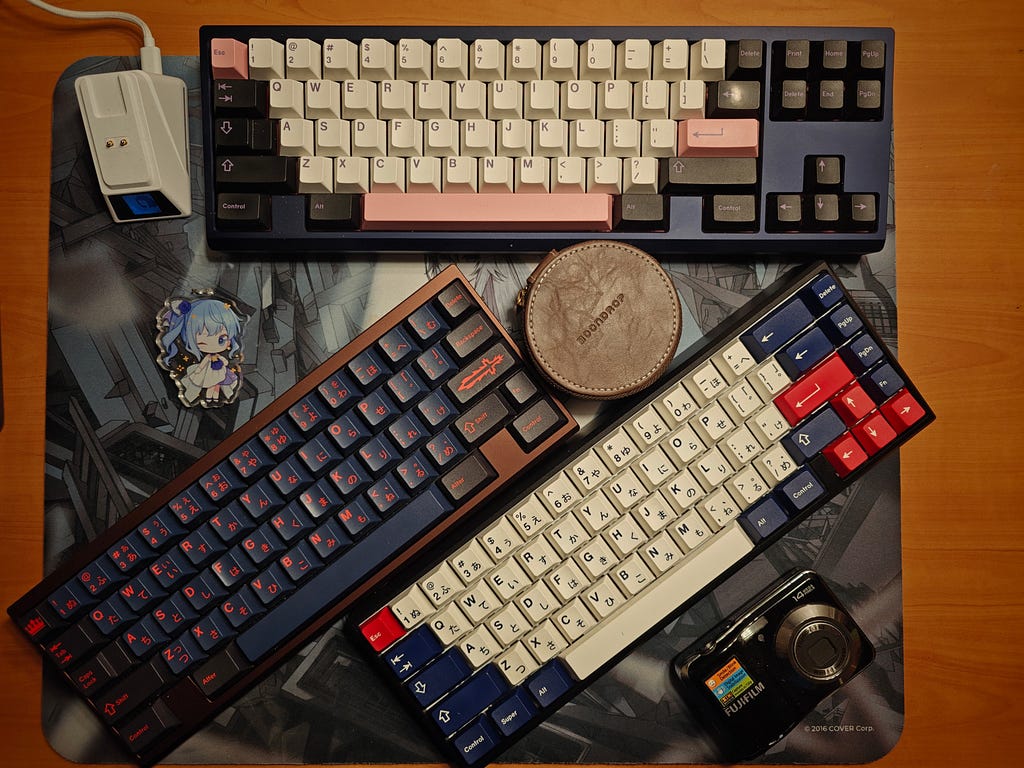 The keyboard collection that started as a harmless upgrade.
Introduction to the madness…
The year is 2022. COVID-19 is wreaking havoc across the globe, and lockdowns have driven people into isolation, yearning for social interaction. Internet culture got louder, stranger, and more online than ever. Wrong script—we’ll save my VTuber opinions for another day.
As the world descended into monotony, a lot of people got sick of working remotely from bed and pretending it was sustainable. But for me, COVID became a strange kind of reset. I rediscovered Linux, indulged in animanga, and picked up hobbies like digital art and playing guitar. However, one pursuit I fell into—a Pandora’s box of expense and obsession—I sometimes rue: custom mechanical keyboards.
It began innocently enough, scrolling through YouTube when I stumbled upon the video by TaehaTypes. It was him building Tfue’s iconic Keycult 1/60—a polarizing board with a pearlescent finish, GMK Striker keycaps, and the tantalizing sound of NovelKeys Cream switches. “How does it sound so good?!” At the time, I was stuck with a gamer keyboard sporting terrible membrane switches. Inspired (and naive), I decided to upgrade to a mechanical keyboard. The next time I went shopping, I found myself perusing the shelves for mechanical keyboards. My first choice was not great in hindsight—a cheap office keyboard with Cherry MX Blue clones—was a disaster. The rattling stabilizers and clicky switches were enough to make me regret the purchase almost immediately. I needed something better.
Leap of faith
Of course, that wouldn’t work for my hobby-obsessed self. So, I joined my local custom keyboard Discord. As usual, nerdy hobbies like this have their share of elitists who make things harder for newcomers. They are the RTFM crowd of the keyboard world, quick to dismiss anything outside their preferred taste. But hey, I was an Arch user, so I was used to this kind of treatment. I stuck around, did my research, and spent far too much time learning about themed keycap sets. I was ready to get my hands dirty and build an actual custom mechanical keyboard.
Humble beginnings
My debut build was a modest GK61 with Gateron Yellow switches and clone GMK Olivia keycaps. After painstakingly tuning stabilizers and experimenting with mods, I spent $120—an astronomical sum for a broke student, thanks to import taxes. In all honesty, any sane person would be happy with this keyboard. But I had clearly fallen deeper into the hobby than expected. A comment on Discord about its hollow sound ruined it for me. I tried everything to fix it—foam, wool, coins—and promptly fried the PCB. Then I ruined a second PCB by ripping out the USB-C port. Why do these cheap boards not provide a daughterboard?
The one with the knob
By 2023, my internship provided disposable income. I upgraded to an Akko MOD008, a gasket-mounted keyboard with, wait for it, a knob. Paired with JTK Night Sakura keycaps (again, clones), it was a significant step up. But my keyboard journey was far from over.
The meetup that changed my life, for the worse
I had the chance to go to a keyboard meetup. My parents were surprised that I decided to fly out 1,000 miles for a keyboard meetup. A bit extreme, yes, but I saw some grail-worthy keyboards that day. I vividly remember the matte black, pearlescent Matrix 8XV 3.0. I tried the goliath of a board, the GeonWorks F1 722 (a great, heavy board, though the build I tried was not my favorite). I also tried some RealForce Topre boards which, at the time, I did not quite enjoy. I saw a mind-boggling plateless Geon W1-AT and a CableCarDesigns Angel (I eventually got my hands on one later). There were some deeply experimental boards too: split keyboards, keyboards with cardboard plates, and other oddities. But I saw something that my mortal self should not have: the E Pluribus Unum, a TGR Jane V2 ME Cherry MX Black build (we will come back to MX Blacks later). It made me question my entire notion of custom keyboards. The velvety anodization, GMK Hammerhead Dark, and amazing PC top-mount typing feel and sound ended up being a Tantalean punishment for me.
Bakeneko60
After that trip, I was dejected with Knobby. The typing felt stiff and sounded pretty muted even with long-pole tactiles (Purple Pandas). One night after work, I saw a local seller importing parts from CannonKeys personally, essentially bypassing the import taxes. This was my chance. It was 4 a.m., Korone’s stream was in the background, and I placed an order for a Bakeneko60 (thanks kkatano). This was like getting the Black Knight Halberd in Dark Souls for me (I am terrible at that game). And of course, I had to challenge myself. No more hotswap. This was a solder-only build—a rite of passage. It had a custom aluminum plate and PCB with support for the Tsangan layout. This layout has a funny story where someone on GeekHack kept asking designers to support it. Take a look at the bottom row in the image below. There is beauty in symmetry as dictated by nature. The R2 backspace makes so much more sense, and of course the stepped caps lock.
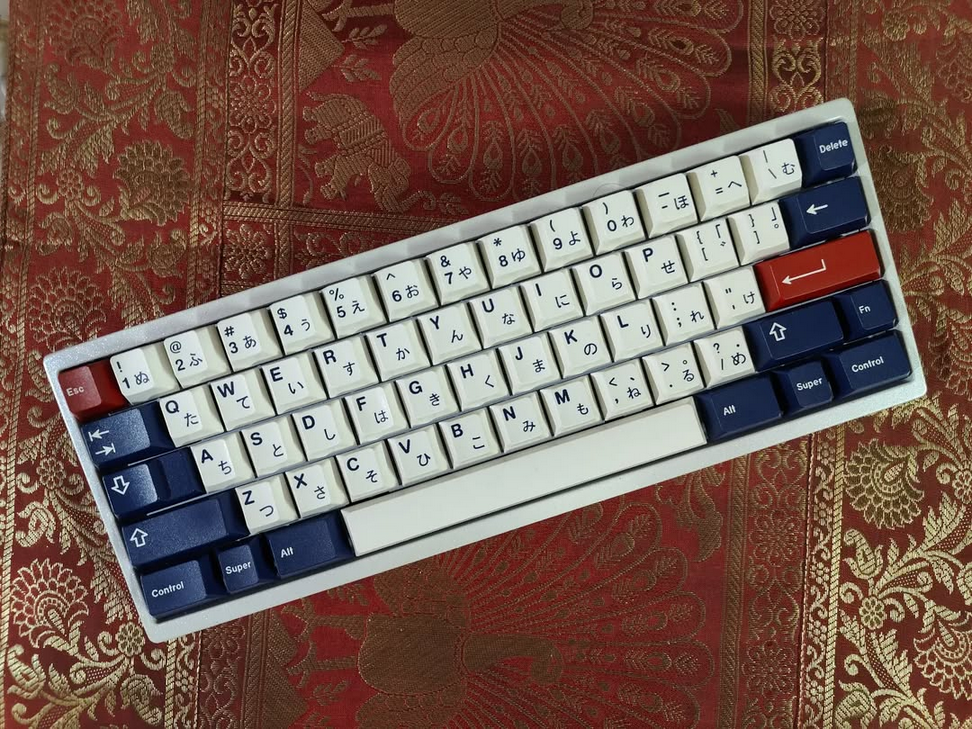 My Tsangan-layout Bakeneko60 build.
Cherry held the patent for MX-style switches until the early 2000s, when the patent ran out. Cherry switches were often criticized for their “poor” feel and inconsistent housing tolerances. So Chinese manufacturers like Kailh and Gateron started making objectively better Cherry clones with smoother stems and tighter housings.
Life is a cycle
I believe, like everything else in the world, “what goes around comes around.” Slowly, people developed nostalgia for old-school Cherry switches. With their secret nylon blend for the housings, Cherry had many unsuccessful replicas. As the hobby exploded, folks saw the old-schoolers swear by lubed and spring-swapped MX Blacks. Some even sourced vintage MX Blacks from old 80s keyboards, especially the West German Nixdorf keyboard switches (which Cherry reintroduced as Nixies). They had a signature sound that no other switch could reproduce. The same switches were lauded for their iconic scratchy feel. This led to a surge in popularity of New Old Stock (switches from old but unused keyboards), Vintage (worn in by use), and Retooled switches. People spent hundreds of dollars on diamond-polished and machine-broken-in MX Blacks. This was insane to me.
I got my hands on some retooled MX Blacks, lubed them, and swapped their springs. Then I wandered upon an Apple of Eden: the Black Cherry Pie. This is considered the gold standard of frankenswitches in forums I would not dare venture into. These sites were either in Korean or looked straight out of 2003. This switch was introduced to me by Shoobs. The influence this guy had on my keyboard taste needs to be studied. So yeah, I painstakingly lubed and spring-swapped each of those 60ish switches and made a BCP for my spacebar. It was also my first time soldering, and I am glad I did it myself because the satisfaction of typing on something I built was hard to beat. So, I was typing on an MX Black Bakeneko (which is modeled after the Singa Unikorn). There was no looking back. MX Blacks had officially ruined every other switch for me. I swapped through some more clone keycap and DCX sets and finally settled on Demon Sword (which is based on Ayanami from Azur Lane). Hence started my obsession with 60% boards and anime-inspired keycap sets. This was a point of no return.
Sinkhole of a hobby
With my spending habit enabled, I entered the treacherous realm of group buys. I saw DBOKEY make a video about a 60%. This was the Fukuro—a $480 Nanashi Mumei-themed keyboard designed by fuyu of Kibou HK. This board, with its intricate copper weight and multiple engravings, was a masterpiece in waiting. It was a raffle, so I had to enter just to get a chance to buy it. Somehow, I won. Happy ending, right? The price tag made me hesitate, and I had my spot rerolled. I could not sleep the next two nights, and when I managed to, I dreamt about the keyboard. I was in deep. Luckily, a friend who won the raffle let me take his spot (thanks daven).
I had a wait of 6–8 months for Fukuro to show up. And yeah, group buys had become risky. At this point, the hobby was dwindling, “trusted” sellers were exit-scamming, and businesses were closing.
While waiting for it to arrive, I quit my job, took the TOEFL and GRE, and scored a CCD Angel and Freebird TKL from MechMarket—a cult favorite with the innovative pinhole mounting style. The plate was mounted on pins on the four corners of the board, giving it an incredibly uniform sound and feel. Built with lubed and spring-swapped CreamPacas (JWK Alpacas with NovelKeys Cream stems), the Angel was everything I’d hoped for, and I paid just $180 (retail was $450). I had it shipped to my friend in Indiana. I also got some aftermarket aluminum, polycarbonate, and polypropylene plates for the Freebird TKL.
My Spending Problem
In fall 2023, I moved to California for grad school. Even before I had the chance to unpack, I hit up my friend in Indiana who had the Angel and coaxed him into exchanging keyboards. I let him have my Bakeneko and a DCX set, and I got the Angel. The moment I shipped it out, I got nostalgic because the Neko was my first truly custom board, and I had soldered it myself. The Angel was as great as I remembered from the meetup. This was my daily driver for a while. I went off the deep end and even got the 2DGF keycap set. I didn’t take a picture of it because the thought of owning this set made me cringe. Here is a picture from their GeekHack though. Oh yeah, I also sold the Freebird because it was kind of mid and flat-sounding, even with all the different plates I’d ordered.
Right before I moved to California, I found a rerun group buy of the cult-classic keycap set GMK Alter. GMK Alter Redux was supposed to fix the weird colors from round one. I am so glad this happened because Alter was being scalped for $500 on MechMarket. Alter is a Saber Alter-themed keycap set, so I had to get my hands on it.
So, at this point I’d received the Fukuro, and it had been sitting unbuilt in the closet for over 10 months. I’d received the Redux keycap set by now too (it took six months). It was summer 2024, and I had yet another internship and some disposable income. I got some Subuwu Pleiades V2 switches manufactured by Meirun. They were supposed to be MX Black replicas but had some mold issues that led to stem shrinkage, so they were offered for very cheap. This was my first top-mount keyboard, and I was excited. And, as is tradition, I managed to damage the non-standard connector. I had to jerry-rig the cable with some solder and tape. I am never opening the Fukuro again. This was a limited-run board (100 units). The velvety coffee color and the weird greys, blacks, and reds of Redux were an unlikely match, but somehow they worked. This aluminum top-mount keyboard with MX Blacks and Korean proportions was a return to tradition. Top-mount aluminum has ruined all other mounting styles for me. Also, the layout is my beloved Winkeyless.
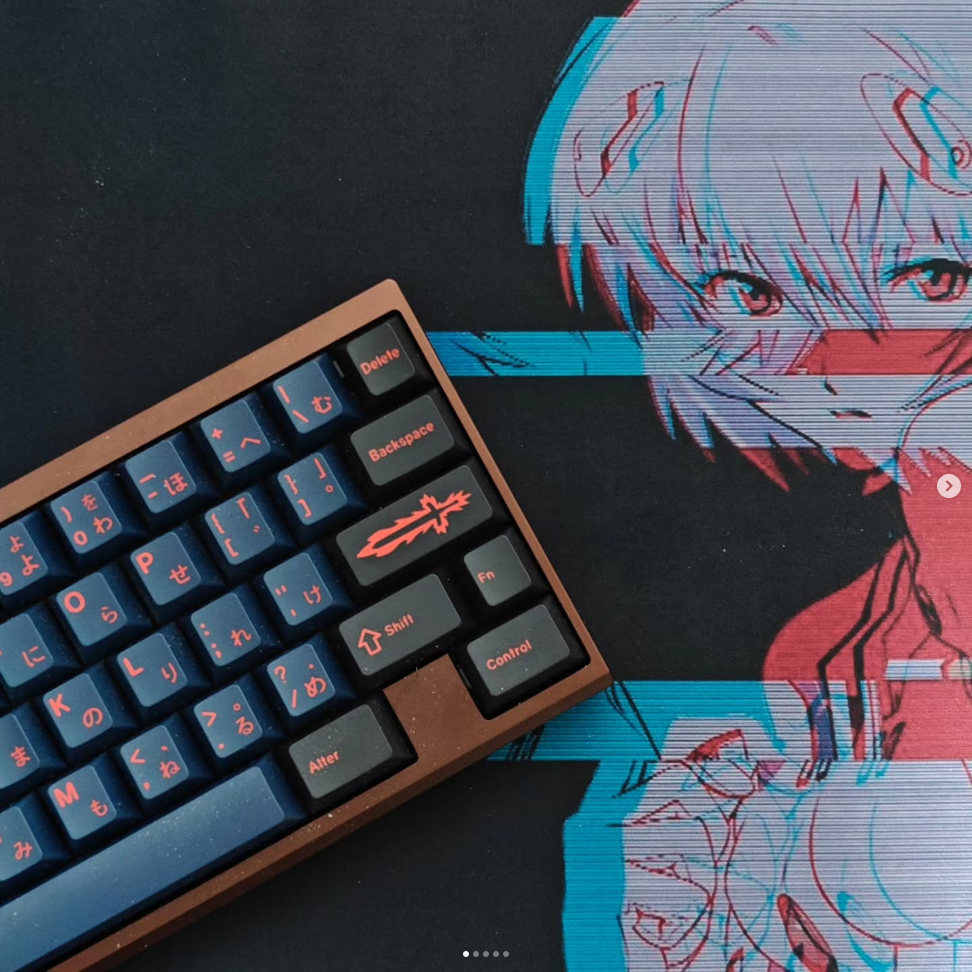 Fukuro with GMK Alter Redux.
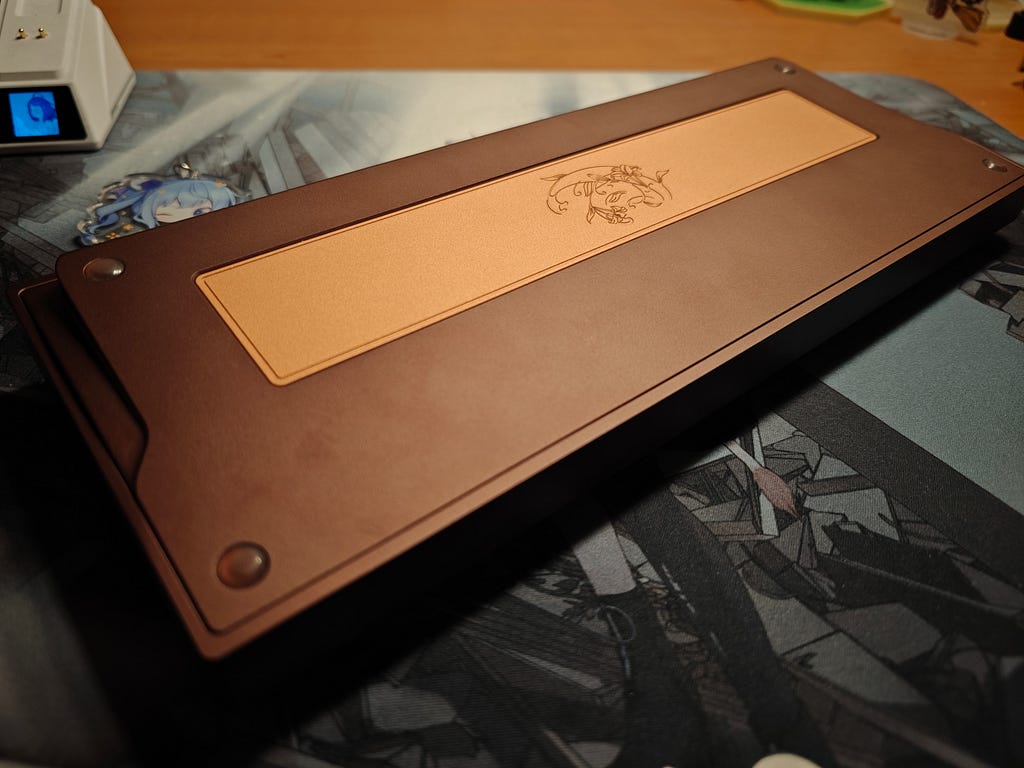 The Fukuro’s engraved back weight.
Imminent Relapse
So, I’d been using Fukuro for about two months. I realized I’d relapsed. This hobby is dangerously easy to fall back into. I’d started checking MechMarket for good deals and found Bachoo’s Crin on sale for $200, which is basically half off. And then there was yet another Fate set, GMK Kouhai, also designed by Bachoo. Bachoo was Shoobs’ editor, and that association alone should make you cautious. His elusive GMK Ishtar keycap set has been my all-time favorite keycap set, but it has been scalped to death. The navy Crin was, in typical fashion, built with awkwardly matching keycaps. While the Alter set feels sharp and intense, Kouhai is calmer and more comfortable, much like the lovable kouhai in Fate/Grand Order, Mashu Kyrielight.
The Crin was built with the polycarbonate plate because I wanted a softer typing experience. With no internal weight, unlike the Fukuro, the Crin holds up by having a thick base that kills most reverberation. My Crin has an unusual layout. It is a Function Row Less Winkey Less Tenkeyless layout (WKLFRLTKL), which is basically a tenkeyless keyboard with the function row chopped off.
After this purchase, I thought I could finally step away from the hobby. But no…
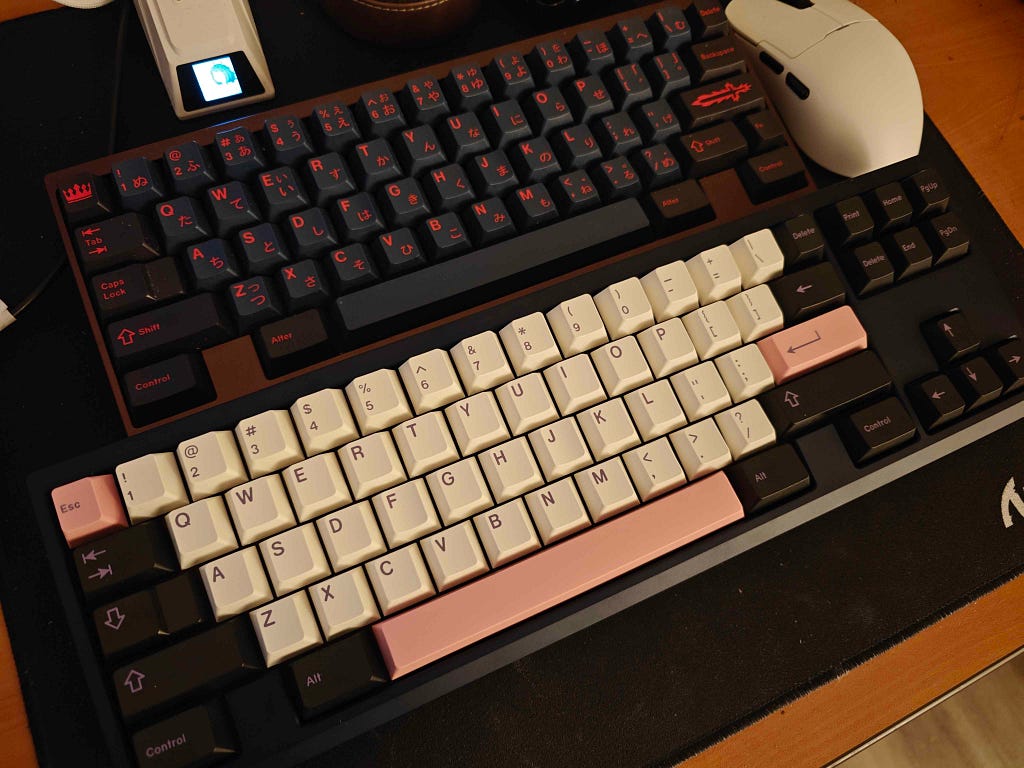 A few of my favorite keyboard builds.
Topre is king
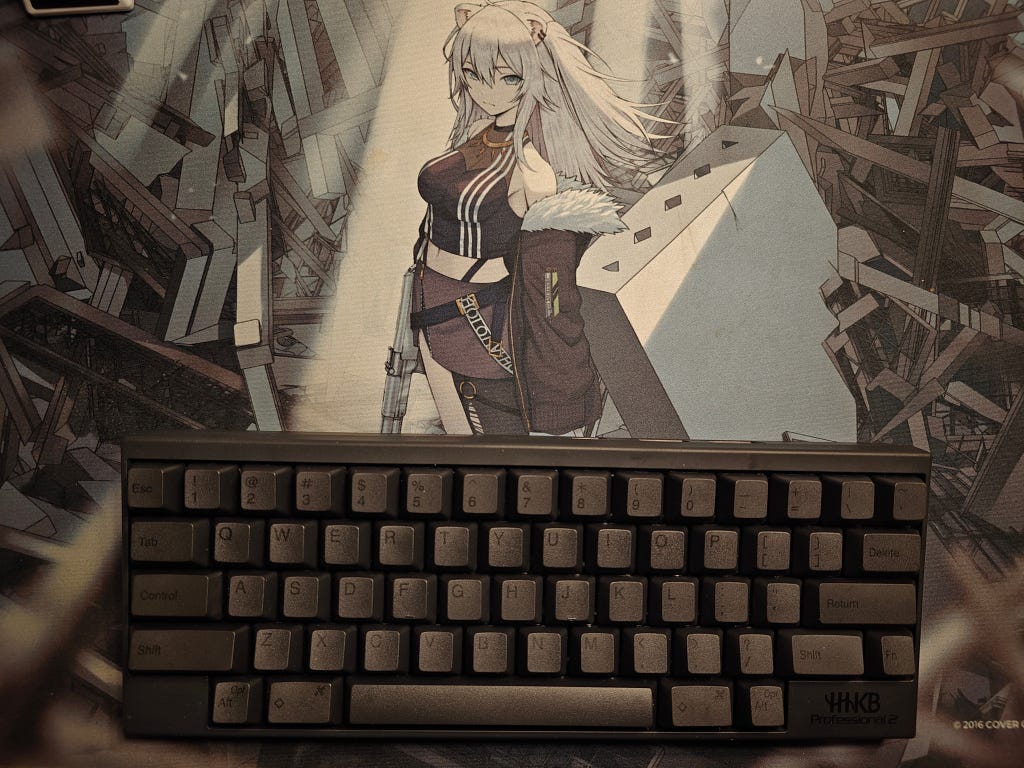 My HHKB Pro 2, the keyboard that changed my mind about Topre.
Throughout my journey in the custom keyboard hobby, I’ve often noticed people retiring from the scene after acquiring an HHKB or another Topre keyboard. I always associated the HHKB with membrane keyboards and couldn’t understand the appeal. So, like any sane person, I went on eBay and bought an HHKB Pro 2 from a Japanese seller clearing out his storeroom—for $130. I had no expectations. Just another keyboard to toss into the closet, right?
Wrong! This keyboard single-handedly inspired this post. There’s something about Eiichi Wada’s vision that completely changed my perspective about prebuilt keyboards (HHKBs are the only prebuilt keyboards worth using). Wada, a computer scientist in the 1990s, was frustrated with the ever-changing keyboard designs and how poorly suited most layouts were for UNIX programming. So, he decided to create his own layout. After several iterations, he finalized what we now know as the HHKB layout.
Wada famously compared keyboards to a cowboy’s saddle. A cowboy might leave a dead horse behind, but they always keep their saddle because it’s an interface that becomes an extension of their body. That explains the HHKB better than any spec sheet. It is built around muscle memory, not features.
These keyboards don’t come cheap. As of 2024, the most affordable HHKB is the HHKB Pro Classic, a Type-C wired version costing $220. The Hybrid model, which offers tri-mode connectivity, comes in at a steep $300. Despite their minimalist and somewhat flimsy plastic cases (which can sound a little hollow and plasticky), the technology underneath is extraordinary.
Topre switches, made by Tokyo Press Kogyo (Topre), are deceptively simple: a spring under a rubber dome collapses onto an electrocapacitive PCB to register keystrokes. Yet, this simplicity delivers unmatched reliability and longevity. My Pro 2 unit is from 2014, and I know people still using HHKBs from 2003. This isn’t just a keyboard; it’s an innovation that’s inspired millions of creators and even influenced mechanical keyboards.
The HHKB is known for its deep sound and unique tactile feedback, qualities that are almost impossible to replicate. As someone who once swore by “clack”—a devout fan of MX Blacks on top mounts—I’ve found myself crossing into enemy territory. A year ago, I would have dismissed many “thocky” builds as chasing trends. But now? I’ll tell you: if we’re going to acknowledge the silly, subjective term “thock,” no keyboard does it better than an HHKB.
After 2.5 years in this hobby, I’ve become, what I believe, a neo-purist. I believe that a well-designed keyboard shouldn’t need “mods” to fix its acoustics or mounting flaws. None of the keyboards I proudly own require such interventions—except the Angel. Its PCB’s flex cuts make it sound thinner than I’d like, but I forgive it because it’s an older design from a time when experimentation drove innovation.
When I first received my HHKB, I opened it up and lubed the sliders and stabilizers. That single change dramatically improved its sound and feel. The HHKB motivates me to find reasons to sit at my desk and type. This keyboard even pushed me to learn Vim just to enjoy typing out my scripts and side projects. It’s a truly amazing device Wada-san has created.
Conclusion
I adore my custom builds like the Fukuro and Crin, which I’ve poured blood, sweat, and tears into crafting. I’ve spent countless hours soldering, troubleshooting janky connectors, and somehow making disparate builds work. These keyboards make up a part of who I am. But I also understand why the HHKB is considered a grail in the custom keyboard community.
The HHKB has reignited my passion for typing and, in a way, given me a new appreciation for simplicity and functionality. This hobby has brought me joy, friendships, and experiences I never expected. Custom keyboards pushed me out of my comfort zone, encouraged me to meet new people, and helped me get involved in a community I genuinely care about.
So, now what? Do I settle down and retire from this tantalizing hobby? Or do I start pricing out Noxary and Norbauer housings like I have learned absolutely nothing?
Would I do it all again? Without hesitation. After all, some treasures (takaramono) are worth the madness.